THE VBP Blog
Missouri LTSS: What a Fee-for-Service Model Means for Consumers
A consumer-focused look at Missouri’s long-term care system, its performance, and how value-based payment is emerging outside MLTSS

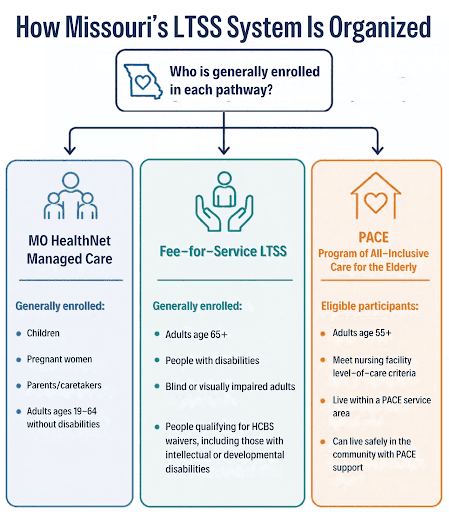
October 7, 2026 – Missouri is an important state to examine in a discussion of managed long-term services and supports because it has not followed the same path as states that moved older adults and people with disabilities into capitated MLTSS. CMS defines MLTSS as the delivery of long-term services and supports through capitated Medicaid managed care. Missouri, by contrast, continues to place seniors age 65 and older, people with disabilities, and blind or visually impaired adults in the MO HealthNet fee-for-service program, while managed care primarily serves children, pregnant women, parents, and adults ages 19 to 64 without disabilities.
That makes Missouri a useful comparison point for the MLTSS states in this series. Its system still has many of the same goals, including supporting people in their homes, coordinating services, preserving choice, and improving quality, but it pursues them without placing most LTSS under managed care organizations. The consumer questions are therefore different: what does Missouri’s fee-for-service approach do well, where does it fall short, and can the state use value-based payment and stronger oversight to improve outcomes without moving to MLTSS?
How Missouri’s LTSS Model Works
For older adults and people with physical disabilities, the Division of Senior and Disability Services (DSDS) plays a central role in access to home and community-based services. DSDS receives referrals, conducts face-to-face assessments, determines whether a person meets program requirements, and works with the participant to develop a person-centered care plan. If eligible, the state authorizes services such as personal care, homemaker assistance, respite, adult day care, home-delivered meals, transportation, home modifications, and medical equipment.
Missouri relies on several HCBS waivers to provide LTSS outside of institutional settings, but the waiver system is divided by population. For older adults, people with physical disabilities, and certain specialized medical populations, Missouri operates waivers including the Aged and Disabled, Independent Living, Adult Day Care, Structured Family Caregiving, Brain Injury, AIDS, and Medically Fragile Adult waivers. Most of these programs are administered through the Missouri Department of Health and Senior Services, with MO HealthNet providing Medicaid oversight. People with intellectual and developmental disabilities are served through a separate system administered by the Department of Mental Health’s Division of Developmental Disabilities (DDD). DDD operates four 1915(c) waivers: Comprehensive, Community Support, Missouri Children with Developmental Disabilities, and Partnership for Hope.
Missouri also offers a more integrated option through PACE in the Springfield, St. Louis, and Kansas City areas. PACE combines Medicare, Medicaid, medical care, LTSS, and social supports for eligible older adults, but it remains geographically limited and does not replace Missouri’s broader fee-for-service LTSS structure.
Value-Based Payment Without MLTSS & What Comes Next
Missouri’s Division of Developmental Disabilities has developed a relatively broad value-based payment program for HCBS providers even though the state does not operate a capitated MLTSS model. For state fiscal year 2026, incentives address areas including Tiered Supports, remote supports, direct support professional training, supported employment, electronic visit verification, workforce data reporting, and health-risk screening. Some payments reward reporting, training, or implementation milestones, while others are tied more directly to provider performance, such as Tiered Supports payments that increase based on the level of organizational implementation. The approach shows that Missouri can build quality incentives directly into its HCBS delivery system without relying on managed care organizations to administer VBP.
The state’s Master Plan on Aging provides a broader roadmap for where that work could go next. The ten-year strategy, shaped by input from more than 10,000 Missourians, calls for reviewing service authorization processes, improving person-centered delivery, strengthening HCBS oversight, establishing an HCBS grievance process, and maintaining access to existing LTSS options. It also specifically calls on Missouri to “build and enhance value-based payment options” tied to quality care and positive outcomes, signaling that VBP could play a larger role beyond the initiatives already underway within the developmental disability system.
Missouri’s current model, however, remains more focused on building the infrastructure for VBP than on rewarding direct consumer outcomes. Many incentives emphasize data collection, workforce development, technology adoption, and provider processes. Going forward, the state could build on that foundation by tying more payments to outcomes consumers experience directly, such as stable staffing, reliable service delivery, employment, community participation, reduced unmet need, and greater choice and control. Other states often pursue these goals through MLTSS plans, but Missouri has an opportunity to demonstrate that stronger outcomes-based purchasing can also be developed within a fee-for-service HCBS system while preserving consumer choice.
How the Current System Performs for Consumers
One of Missouri’s clearest strengths is its emphasis on home and community-based care. According to CMS data for 2023, 69.7% of the state’s Medicaid LTSS expenditures went to HCBS rather than institutional services. That placed Missouri in the highest quartile of states on the expenditure-rebalancing measure and suggests that a fee-for-service model has not prevented the state from directing a substantial share of LTSS spending toward community-based care.
Consumer survey results continue to show strengths in choice and control. In Missouri’s 2024–2025 National Core Indicators-Aging and Disabilities survey, 86% of respondents said they could choose or change all of their services, compared with an 81% weighted average across participating states. 74% said they could choose when and how often services were provided, compared with 73% across participating states, while 85% said they could choose or change all of the people providing their paid supports, compared with 84%. 85% also knew whom to contact to make a complaint about their services, compared with 78% across participating states.
While those results show that Missouri is above nationwide averages (for participating states) in some respects, they do not mean the system meets every need. 73% of respondents said their services completely met all current needs and goals, leaving more than one-quarter reporting at least some unmet need. Among respondents with unmet needs who had a case manager, only 39% said the case manager had discussed services that might help, compared with a 51% weighted NCI-AD average. Only 68% of people relying on paid support workers said they had a backup plan if those workers did not show up. The findings point to an important distinction that consumer choice is valuable, but choice has limited meaning when needed services or workers are unavailable.
Workforce and Access Remain Significant Pressure Points
Missouri’s direct care workforce data helps explain some of those access concerns. The state’s 2025 Year 3 workforce report found a median direct service worker turnover rate of 29% among responding agency-model providers. Providers reported an average full-time vacancy rate of 13%, and 36% said staffing problems forced them to turn away or stop accepting new service referrals. Those figures improved from earlier survey cycles, but they still show how workforce shortages can turn an authorized care plan into services a consumer cannot reliably receive.
Recent policy changes also create new consumer considerations. Effective July 1, 2026, Missouri established a 49-hour-per-week limit on Independent Living Waiver services and a separate 49-hour weekly limit on respite services under the Aged and Disabled Waiver. DSDS began adjusting care plans above the new limit for implementation beginning September 1. For consumers with high support needs, a uniform service ceiling can have significant consequences if alternative supports are not available. This makes person-centered reassessment, clear communication, and monitoring of unmet need particularly important.
Advocate’s Perspective
Missouri provides an important reminder that managed care is not the only path to a more community-based LTSS system. The state directs a substantial share of Medicaid LTSS spending to HCBS, and consumer surveys show comparatively strong results for choice over services, schedules, and paid support workers. At the same time, workforce shortages, gaps in follow-up when needs are unmet, and new limits on some HCBS demonstrate that fee-for-service does not eliminate access problems. The next phase should build on Missouri’s strengths without sacrificing flexibility and self-direction. The Master Plan on Aging gives the state an opportunity to strengthen grievance protections, service authorization, workforce capacity, and value-based payment, and as always, the measure of success should be whether consumers can translate choice on paper into reliable services, meaningful independence, and the ability to live safely in the setting they prefer.
Onward!

Free E-Book
Paying for Outcomes: The Value-Based Revolution Written by Fady Sahhar
A practical guide for payers, providers, and policymakers shaping the next generation of healthcare delivery.
Now Available for Free
DOWNLOAD NOW
Share This Blog!
Get even more insights on Linkedin & Twitter

About the Author
Fady Sahhar brings over 30 years of senior management experience working with major multinational companies including Sara Lee, Mobil Oil, Tenneco Packaging, Pactiv, Progressive Insurance, Transitions Optical, PPG Industries and Essilor (France).
His corporate responsibilities included new product development, strategic planning, marketing management, and global sales. He has developed a number of global communications networks, launched products in over 45 countries, and managed a number of branded patented products.
About the Co-Author
Mandy Sahhar provides experience in digital marketing, event management, and business development. Her background has allowed her to get in on the ground floor of marketing efforts including website design, content marketing, and trade show planning. Through her modern approach, she focuses on bringing businesses into the new digital age of marketing through unique approaches and focused content creation. With a passion for communications, she can bring a fresh perspective to an ever-changing industry. Mandy has an MBA with a marketing concentration from Canisius College.
Lorem ipsum dolor sit amet, consectetur adipiscing elit. Ut elit tellus, luctus nec ullamcorper mattis, pulvinar dapibus leo.