THE VBP Blog
California MLTSS: Has CalAIM Created a More Integrated Long-Term Care System?
California has moved institutional LTSS and dual-eligible coordination deeper into managed care, but its home and community-based system remains divided across programs and delivery models.

October 28, 2026 – California has spent years moving toward a more integrated Medicaid delivery system, and long-term services and supports (LTSS) are increasingly part of that transformation. But California does not have a single, fully integrated MLTSS system. Managed care plans cover institutional LTSS and Community-Based Adult Services, while major home and community-based (HCBS) programs and waivers continue to operate outside the managed care benefit.
DHCS itself has described its long-term goal as greater integration across a system that remains administratively complex. The central consumer question is therefore not simply whether California has MLTSS, but whether its expanding managed care structure is making it easier for people to obtain the right services in the setting they prefer.
How California’s MLTSS Model Works
Under California Advancing and Innovating Medi-Cal (CalAIM), Medi-Cal managed care plans have assumed responsibility for institutional long-term care statewide, while the state has also expanded care management and integrated options for people eligible for both Medicare and Medi-Cal. The result is a much larger managed care role in LTSS than California had only a few years ago.
The most significant change under CalAIM has been the statewide long-term care carve-in. Beginning January 1, 2023, Medi-Cal managed care plans became responsible for long-term care provided in skilled nursing facilities, including both freestanding and hospital-based SNFs. On January 1, 2024, that responsibility expanded to adult and pediatric subacute facilities and Intermediate Care Facilities for individuals with developmental disabilities. Institutional Medi-Cal LTSS is therefore now broadly administered through managed care rather than fee-for-service.
California’s community-based side is more complicated. Community-Based Adult Services (CBAS), which provides nursing, therapies, personal care, social services, meals, and transportation to eligible older adults and adults with disabilities, is a managed care benefit. But most HCBS remain outside the Medi-Cal managed care benefit. Programs such as In-Home Supportive Services (IHSS), the Home and Community-Based Alternatives Waiver, Assisted Living Waiver, and Multipurpose Senior Services Program continue to operate through separate program and waiver structures, while CBAS is the primary HCBS benefit included in managed care.
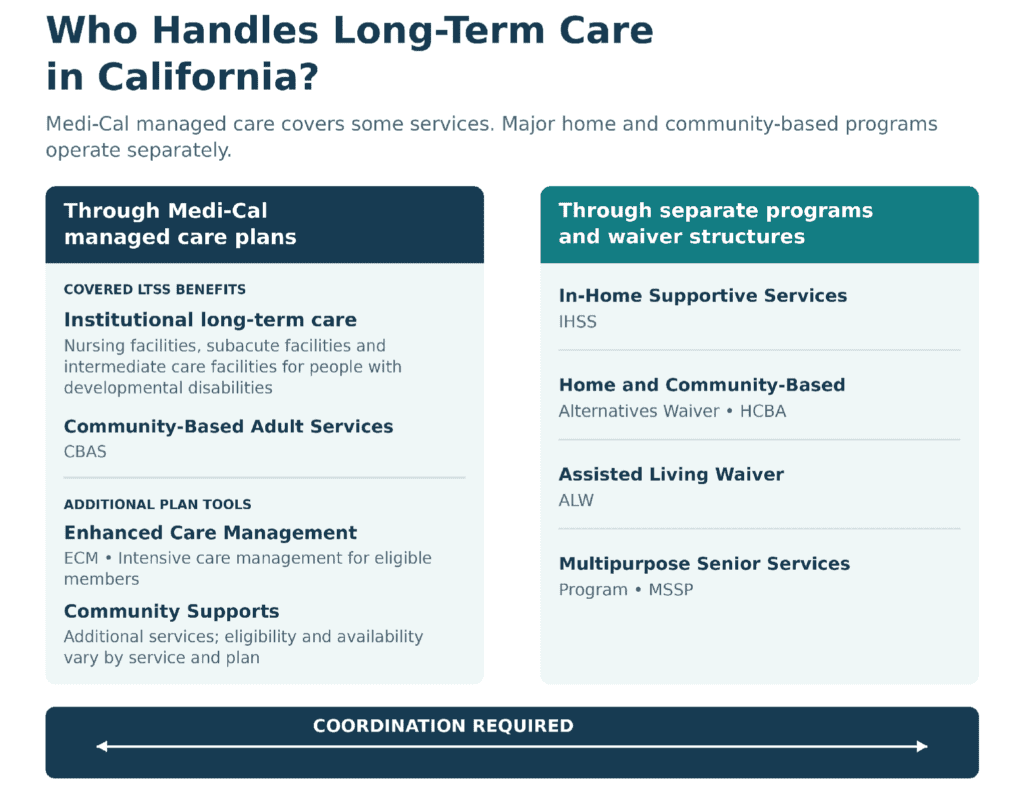
That distinction matters for consumers. A Medi-Cal plan may be responsible for someone’s physician care, hospital services, and nursing facility stay, but another entity may determine eligibility, authorize, or deliver the services that allow the same person to return home. Managed care plans are required to coordinate with programs such as IHSS, including through formal agreements with local agencies, but coordination is not the same as placing those services under the plan’s capitation payment.
But there are changes being made to address this. An upcoming change in December 2026 aims to transition select HCBS waivers into Medi-Cal managed care, but it remains to be seen how that rolls out. CalAIM has also tried to bridge some of those gaps through Enhanced Care Management and Community Supports. ECM provides intensive care management for populations that include adults at risk of institutionalization and nursing facility residents seeking to return to the community. Community Supports can include assisted living transitions, community or home transition services, personal care and homemaker services, respite, and home modifications. These services give plans tools to prevent or shorten institutional stays even when the state’s larger HCBS programs remain outside managed care.
Dual Eligibles Move Toward Greater Integration
California’s MLTSS transformation is particularly important for people eligible for both Medicare and Medi-Cal. Full-benefit dual-eligibles generally receive their Medi-Cal benefits through managed care, while Medicare remains the primary payer for Medicare-covered medical services. California reports approximately 1.7 million dual-eligible members, and nearly all of whom enrolled are full duals.
The state is increasingly encouraging those beneficiaries to receive both sides of their coverage through Medicare Medi-Cal Plans, or Medi-Medi Plans. These are integrated D-SNP arrangements in which an affiliated Medicare Advantage plan and Medi-Cal managed care plan coordinate Medicare, Medi-Cal, and LTSS benefits. Enrollment remains voluntary, and while Medi-Medi Plans had been available in 12 counties, in 2026, availability expanded into 29 additional counties, bringing the model to 41 counties
DHCS also expanded its Medi-Cal “matching plan” policy statewide in 2026. Under that policy, when a dual eligible voluntarily chooses a Medicare Advantage plan with an affiliated Medi-Cal plan, the Medi-Cal enrollment generally follows that Medicare choice.
For consumers, aligned enrollment has a clear potential advantage in that one organization has greater responsibility for coordinating medical care, medications, transportation, and LTSS rather than requiring the member to navigate separate Medicare and Medicaid organizations. But even an integrated Medi-Medi Plan must coordinate with benefits that remain carved out, including IHSS. California has therefore moved closer to Medicare-Medicaid integration without eliminating the underlying fragmentation of its HCBS system.
A Strong HCBS Footprint, But Significant Access Gaps
California’s community-based system presents an interesting contrast. DHCS reported that more than 90% of Medi-Cal members using LTSS received HCBS, reflecting the reach of programs such as IHSS and other community supports. Yet CMS’s national expenditure analysis shows that only 47.5% of California Medicaid LTSS spending went to HCBS in 2023, placing California in the lowest quartile of states on the expenditure measure. Nationally, HCBS accounted for 63.8% of Medicaid LTSS expenditures that year.
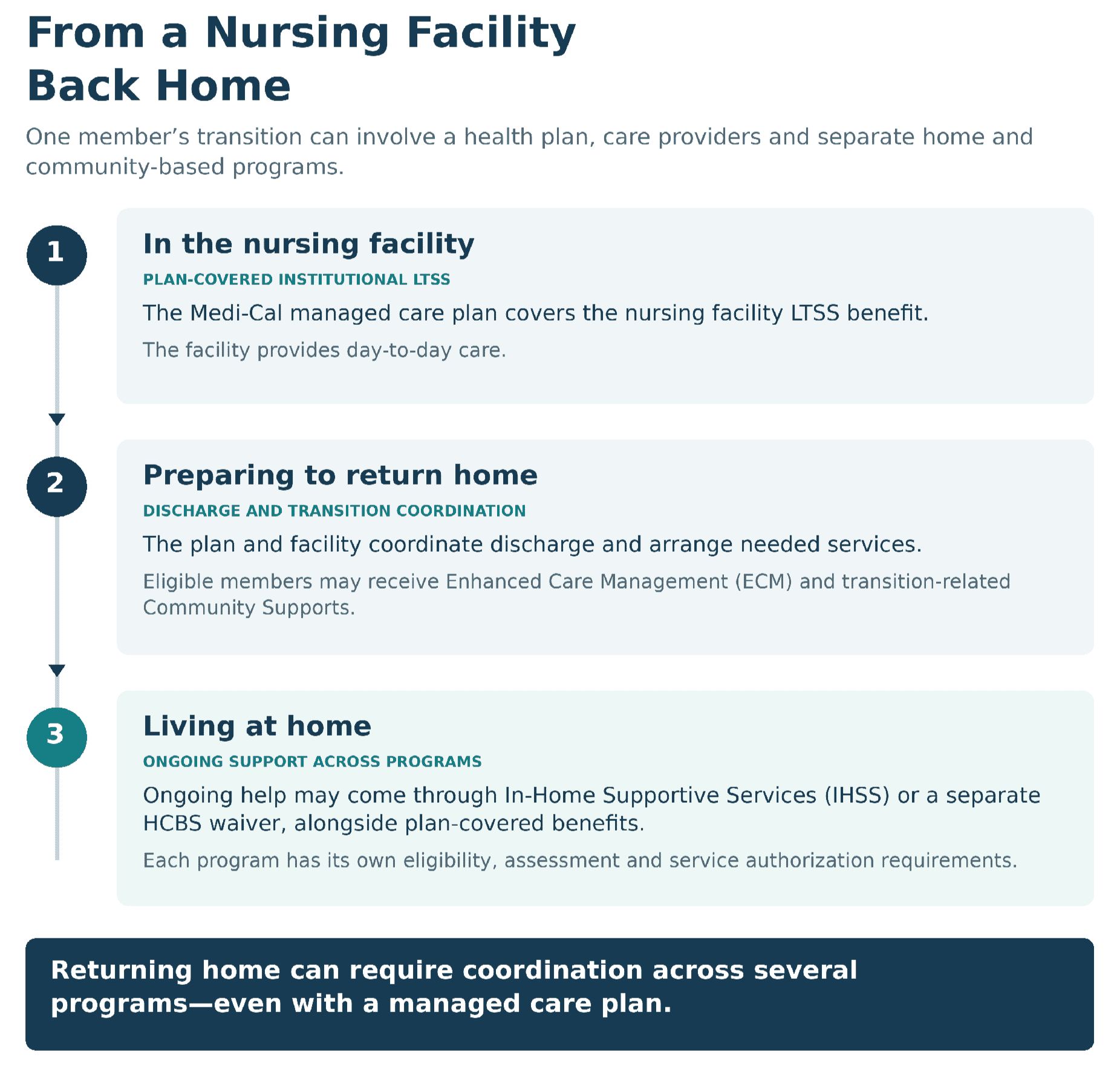
Those measures capture different things, but together they illustrate an important point that serving large numbers of people in the community does not necessarily mean that Medicaid resources are similarly balanced toward community care.
California’s own 2025 HCBS Gap Analysis identifies additional weaknesses. DHCS found that the population is aging particularly quickly in areas where HCBS access is already limited, institutional LTSS use is higher in rural areas, and the state will need more HCBS providers to meet future demand. Direct care workers were identified as the largest workforce need. The analysis also emphasizes disparities in access and the administrative difficulty consumers face navigating multiple programs.
There are encouraging signs within CalAIM. By the third quarter of 2025, nearly 191,000 Medi-Cal members were using at least one Community Support during the quarter. DHCS has also reported preliminary cost reductions associated with services intended to keep people out of higher-cost settings, including assisted living transitions, community or home transition services, respite, and home modifications.
Still, Community Supports are not a replacement for a comprehensive HCBS system. Availability varies by plan and service, and the core question remains whether consumers can move smoothly from institutional care to the ongoing services they need at home.
Value-Based Payment and What Comes Next
California has also experimented with linking LTSS payment to quality. Beginning in 2023, the Skilled Nursing Facility Workforce and Quality Incentive Program operated as a managed-care directed payment program rewarding participating facilities for workforce, clinical, and equity measures. More than $304 million was targeted for the 2025 program year. However, the 2025-26 state budget ended WQIP effective December 31, 2025, leaving California’s nursing facility value-based strategy in transition.
The larger opportunity, however, extends beyond facilities. CalAIM has incorporated value-based payment through several mechanisms, although relatively few are specific to LTSS. The CalAIM Incentive Payment Program rewarded managed care plans for building capacity, expanding Enhanced Care Management and Community Supports, and improving quality and utilization, including in LTSS-related areas. More broadly, the state’s Quality Withhold and Incentive Program now links a portion of managed care capitation to quality and member-experience measures.
For consumers, the goal should not simply be to place more benefits under an MCO contract. Greater integration has value only if it makes access easier, strengthens transitions back to the community, and creates clearer accountability when services are unavailable. California already gives managed care plans responsibility for costly institutional care. The next challenge is ensuring those plans have both the tools and incentives to help people avoid unnecessary institutionalization in the first place.
Advocate’s Perspective
California has made meaningful progress toward integrating long-term care into Medi-Cal managed care. Statewide responsibility for nursing facilities, expanded Medi-Medi Plans, Enhanced Care Management, and Community Supports all give health plans a larger role in coordinating care across settings. For consumers who previously moved between disconnected systems with little accountability for the whole person, that can be an important improvement. But California’s system remains difficult to describe because it remains difficult to navigate, and the state’s own gap analysis confirms that provider capacity, workforce shortages, geographic disparities, and administrative fragmentation continue to limit access. The next phase of reform should therefore be judged less by how many additional programs California can label “managed” and more by whether consumers experience the system as integrated.
Onward!

Free E-Book
Paying for Outcomes: The Value-Based Revolution Written by Fady Sahhar
A practical guide for payers, providers, and policymakers shaping the next generation of healthcare delivery.
Now Available for Free
DOWNLOAD NOW
Share This Blog!
Get even more insights on Linkedin & Twitter

About the Author
Fady Sahhar brings over 30 years of senior management experience working with major multinational companies including Sara Lee, Mobil Oil, Tenneco Packaging, Pactiv, Progressive Insurance, Transitions Optical, PPG Industries and Essilor (France).
His corporate responsibilities included new product development, strategic planning, marketing management, and global sales. He has developed a number of global communications networks, launched products in over 45 countries, and managed a number of branded patented products.
About the Co-Author
Mandy Sahhar provides experience in digital marketing, event management, and business development. Her background has allowed her to get in on the ground floor of marketing efforts including website design, content marketing, and trade show planning. Through her modern approach, she focuses on bringing businesses into the new digital age of marketing through unique approaches and focused content creation. With a passion for communications, she can bring a fresh perspective to an ever-changing industry. Mandy has an MBA with a marketing concentration from Canisius College.
Lorem ipsum dolor sit amet, consectetur adipiscing elit. Ut elit tellus, luctus nec ullamcorper mattis, pulvinar dapibus leo.