THE VBP Blog
Florida’s MLTSS Model: How the State’s Long-Term Care Program Works for Consumers
How Florida structures access, coordination, and long-term care through managed Medicaid

June 17, 2026 – Florida is an important state to watch in any discussion of managed long-term services and supports (MLTSS) because it has one of the clearest formal MLTSS structures in the country. The state delivers MLTSS through its Statewide Medicaid Managed Care program (SMMC). The state updated this broader system through SMMC 3.0 beginning February 1, 2025, making it a useful example of how a large state continues to refine its managed care model over time.
Florida stands out not just because it has a statewide long-term care program, but because the consumer experience depends on how well the state’s multi-agency structure works in practice. On paper, there is a defined pathway into services, but in practice, consumers may have to move through screening, eligibility, and enrollment across multiple agencies before they ever receive care. That makes Florida a strong case study in both the promise and the complexity of MLTSS.
What Florida’s LTC Program Is and Who It Is Meant to Serve
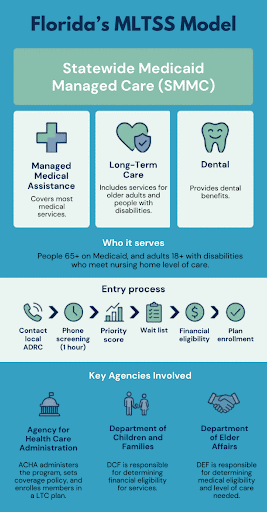
In Florida, most Medicaid recipients are enrolled in the Statewide Medicaid Managed Care program. The program has three parts: Managed Medical Assistance, Long-Term Care, and Dental. Florida’s MLTSS model is the Long-Term Care component of the broader SMMC program.
The people Florida’s LTC program is meant to serve are also defined fairly clearly. According to the state, eligible individuals include people age 65 and older who qualify for Medicaid, as well as adults age 18 and older who qualify for Medicaid due to a disability and are determined by the Department of Elder Affairs’ CARES program to meet nursing home level of care, or hospital level of care for persons with cystic fibrosis. That means Florida’s model is aimed at people with significant long-term care needs rather than a broader Medicaid population. From a consumer advocate’s perspective, that clarity is a strength, but it also comes with a tradeoff. Because the program depends on both medical and financial eligibility decisions made by different agencies, the pathway into care can be harder to navigate than the eligibility criteria first suggest. In other words, Florida does a reasonably good job of defining who the program is for, but the consumer experience is still shaped by how well those separate eligibility steps work together in practice.
The Florida Agency for Health Care Administration (AHCA) administers the LTC program, sets coverage policy, and enrolls eligible individuals in a long-term care plan, while the Department of Children and Families handles financial eligibility and the Department of Elder Affairs determines medical eligibility and level of care. That structure gives Florida a clearly defined program rather than a loose collection of long-term care services, which is one of the things the state does well. Consumers are not left guessing about whether there is a formal MLTSS pathway. On paper, there is.
How People Enter the Program and Where Consumer Friction Begins
In Florida, while some individuals are not required to complete a screening process, for most people getting into the Long-Term Care program is not as simple as meeting a general eligibility category. People must first contact their local Aging and Disability Resource Center, which conducts a phone screening that typically takes about an hour. That screening is used to assign a priority score and rank, and individuals are then placed on the state’s LTC wait list if they appear potentially eligible.
Only after that step can a person move further into the process, including financial eligibility review and plan enrollment. From the state’s perspective, this creates a structured method for prioritizing people with the greatest need. From a consumer perspective, though, it also means access to services can depend heavily on a front-end process that may feel lengthy, technical, and hard to predict.
This is one of the clearest places where consumer friction begins. Florida does some things well here. It has a defined screening system, a formal prioritization process, and an established route into managed long-term care rather than an informal or inconsistent pathway. At the same time, the experience can still be difficult for consumers and families to navigate. A person may have to interact with the ADRC system, wait for release from the list, complete financial eligibility steps, and then choose and enroll in a managed care plan before services actually begin. For someone already dealing with significant health or functional needs, that is a lot to manage and can delay access to necessary care and services. This is an important reminder that a program may be well designed on paper, but if the path into care is confusing or delayed, the consumer experience can still fall short.
The Regional Approach and It’s Impact on Consumers
Florida uses a regional model to organize its SMMSC program, including long-term care. Under SMMC 3.0, the state groups counties into designated service regions and awards plan contracts within those regions rather than treating the entire state as one uniform market. That means a consumer’s available plans, provider networks, and enrollment options can depend in part on where they live.
The regional approach can benefit consumers when it aligns plans more closely with real provider networks and referral patterns. That can make plan options more relevant to how care is actually delivered in a person’s area and may support more consistent oversight across plans. At the same time, regions can hurt consumers when they create disruption or make the system harder to navigate. If a person moves and changes regions, they may need to choose a new plan, which can interrupt continuity for someone relying on long-term services and supports. Even without moving, consumers still must understand which plans operate in their region and how plan change rules work.
What Florida’s Model Gets Right and Where It Still Falls Short
Florida’s model gets some important things right. It has a formal statewide managed care structure rather than a fragmented set of local long-term care arrangements. Florida also built its broader managed care system to include different plan types that can deliver both MMA and LTC services, which creates at least some opportunity for better coordination when members are enrolled across program components.
The state also spells out a defined set of LTC covered services, including care coordination, personal care, adult day health care, respite, home-delivered meals, nursing facility care, and other supports that are central to long-term services and supports. That kind of scale and structure matters because it can create more consistency in what people are told to expect and what plans are responsible for delivering.
In addition, there is also a value-based payment (VBP) component in the LTC program. The LTC contract allows the state to use a quality withhold and a quality preferred assignment incentive tied to high performance on LTC quality measures, and it says plans can keep up to an additional 1 percent of revenue in the first year if they exceed thresholds on specific MLTSS measures such as comprehensive assessment, comprehensive care plans, shared care plans with primary care practitioners, and reassessment after inpatient discharge. Florida also uses a Community High Risk Pool in the LTC program to help account for the cost of serving members with intensive home and community-based service needs. This shows that Florida is trying to connect payment to care quality and community-based performance, but the real test is whether those financial incentives lead to better coordination, more timely services, and a smoother experience for people relying on long-term care.
At the same time, Florida’s model still falls short in ways that directly affect consumer experience. A program can be highly organized on paper and still feel difficult to navigate in real life. In Florida, access depends not only on need, but also on screening, waitlist release, financial eligibility, and plan enrollment across multiple entities before services begin. That’s not to mention navigating the various regions, and how plans may change if a member moves.
For consumers, the real test is not whether the system is formalized, but whether it is understandable, timely, and capable of connecting people to the right services without unnecessary confusion or delay.
Advocate’s Perspective
Florida shows that MLTSS is only as strong as the consumer experience it creates. The state has a formal, statewide managed care structure for LTSS, clear eligibility categories, and a defined entry process, all of which can create consistency and accountability. But from a consumer perspective, those strengths only matter if people can actually move through the system without confusion, delay, or unnecessary burden. In Florida, access depends on multiple steps, plan enrollment, and location, which can make the process feel complicated before services even begin. That makes Florida a useful example of a larger MLTSS lesson: good program design is not just about contracts, plan structure, or enrollment totals. It is also about whether consumers and families can understand the system, get connected to services in a timely way, and feel that managed care is making long-term supports easier to coordinate rather than harder to access.
Onward!

Free E-Book
Paying for Outcomes: The Value-Based Revolution Written by Fady Sahhar
A practical guide for payers, providers, and policymakers shaping the next generation of healthcare delivery.
Now Available for Free
DOWNLOAD NOW
Share This Blog!
Get even more insights on Linkedin & Twitter

About the Author
Fady Sahhar brings over 30 years of senior management experience working with major multinational companies including Sara Lee, Mobil Oil, Tenneco Packaging, Pactiv, Progressive Insurance, Transitions Optical, PPG Industries and Essilor (France).
His corporate responsibilities included new product development, strategic planning, marketing management, and global sales. He has developed a number of global communications networks, launched products in over 45 countries, and managed a number of branded patented products.
About the Co-Author
Mandy Sahhar provides experience in digital marketing, event management, and business development. Her background has allowed her to get in on the ground floor of marketing efforts including website design, content marketing, and trade show planning. Through her modern approach, she focuses on bringing businesses into the new digital age of marketing through unique approaches and focused content creation. With a passion for communications, she can bring a fresh perspective to an ever-changing industry. Mandy has an MBA with a marketing concentration from Canisius College.
Lorem ipsum dolor sit amet, consectetur adipiscing elit. Ut elit tellus, luctus nec ullamcorper mattis, pulvinar dapibus leo.